8 Experiential Science Experiments to Spark Curiosity and Wonder
Science education plays a crucial role in fostering curiosity, critical thinking, and problem-solving skills in students. Traditional classroom learning often relies heavily on textbooks and lectures, but there is an increasing recognition of the value of hands-on experiences in science education. Experiential science experiments allow students to actively engage with scientific concepts, observe phenomena firsthand, and develop a deeper understanding of the world around them.
In this article, we will explore eight experiential science experiments that are sure to ignite curiosity and wonder in young minds. These experiments can be conducted both at home or in alternative schooling settings, providing an exciting opportunity for exploration outside traditional classrooms.
1. The Egg Drop Experiment:
Challenge your budding engineers with the classic egg drop experiment. Students are tasked with building a protective contraption using everyday materials such as straws, rubber bands, and paper cups to prevent an egg from breaking when dropped from a designated height. This experiment not only teaches principles of physics but also encourages creativity and problem-solving skills.
2. Solar-Powered Oven:
Harnessing solar energy is not only environmentally friendly but also provides an excellent opportunity for learning about heat transfer. In this experiment, students construct their own solar-powered ovens using cardboard boxes covered with aluminum foil or black construction paper. They can then use these ovens to cook simple recipes like s’mores or melt chocolate bars while exploring concepts like reflection and absorption of sunlight.
3. Water Cycle Terrarium:
The water cycle is a fundamental concept taught in schools across the globe. However, creating a terrarium allows students to witness this process up close and personal. By filling a clear container with soil, plants, rocks, water droplets on the sides of the container simulate rain falling onto land while condensation occurs under direct sunlight within the terrarium’s microclimate—providing visible evidence of evaporation.
4. DIY Volcano:
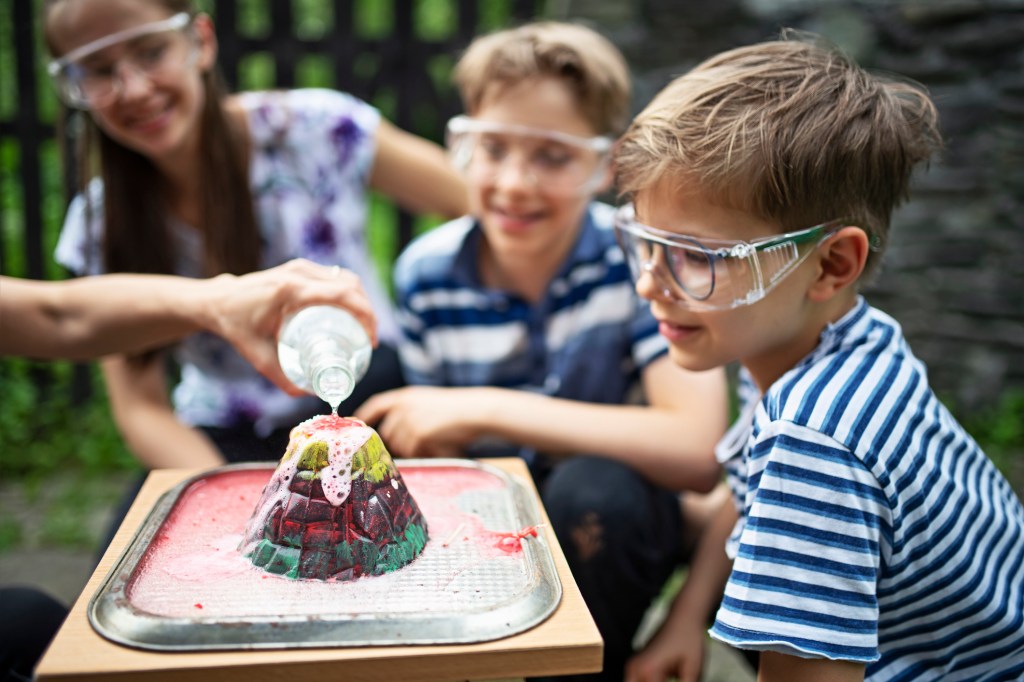
The classic volcano experiment never fails to captivate students’ attention. By combining everyday household items such as baking soda, vinegar, and food coloring, students can create a volcanic eruption right in their classroom or backyard. This experiment provides an excellent opportunity to discuss chemical reactions while observing the forces of nature in action.
5. Static Electricity Dance Party:
Electricity is fascinating and often perplexing for young minds. To introduce the concept of static electricity, organize a dance party with balloons and some upbeat music. Students rub balloons against their hair or clothing to generate static charges that attract confetti or bits of paper suspended from strings. The floating particles will spark curiosity about how electrical charges work and why they attract certain materials.
6. Oobleck Exploration:
Oobleck is a non-Newtonian fluid that behaves differently depending on the force applied to it—solid when pressure is applied, but liquid when allowed to flow freely. This experiment involves mixing cornstarch with water until achieving the desired consistency and then inviting students to explore its unique properties by poking it, squeezing it, or even walking on top of it! Through this hands-on activity, children learn about states of matter and viscosity.
7. Dissecting Owl Pellets:
For those interested in life sciences, dissecting owl pellets offers an exciting way to explore animal anatomy and ecology through hands-on investigation. Owl pellets are regurgitated masses containing undigested bones from prey animals eaten by owls—the perfect subject for budding scientists! Students can carefully dissect these pellets using tweezers and magnifying glasses to identify different species’ bones—a fascinating exercise in understanding predator-prey relationships.
8. Circuit Building Challenge:
Electronics play a significant role in our daily lives; understanding circuits is essential knowledge for future generations. In this experiment, provide students with basic circuit components such as batteries, wires, light bulbs, switches—and challenge them to build functioning circuits. This hands-on experience will introduce them to the fundamentals of electricity and circuitry while fostering problem-solving skills.
By incorporating these experiential science experiments into alternative schooling curricula or homeschooling routines, educators can provide students with engaging and memorable learning experiences that foster a lifelong love for science. These hands-on activities promote critical thinking, creativity, and curiosity—qualities that are invaluable in any field of study or career path. So, let’s roll up our sleeves and embark on an exciting journey of scientific exploration!
 Alternative Amie
Leave a comment