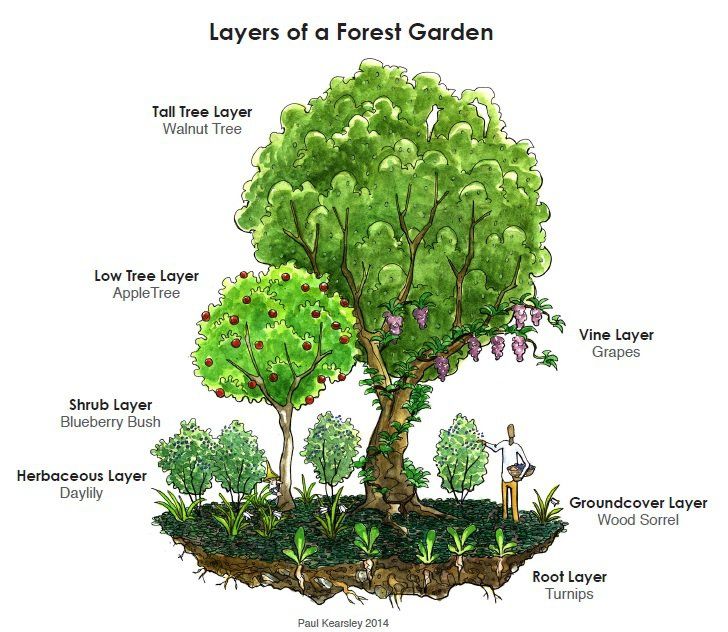
Forest gardening, also known as food forest or edible forest gardening, is a sustainable and low-maintenance way of growing food that mimics the structure and function of a natural forest ecosystem. This innovative approach to agriculture combines fruit and nut trees, shrubs, herbs, vines, and perennial vegetables in a layered system that maximizes biodiversity and productivity while minimizing the need for external inputs such as fertilizers or pesticides.
One of the key principles of forest gardening is planting in layers to make use of vertical space and create diverse habitats for plants and wildlife. The canopy layer consists of tall fruit and nut trees like apples, pears, cherries, and walnuts; the understory layer contains smaller fruit trees like plum or apricot; the shrub layer includes berries such as raspberries or currants; the herbaceous layer features perennial vegetables like asparagus or rhubarb; the groundcover layer comprises low-growing plants like strawberries or mint; and finally, the root zone includes tubers like potatoes or Jerusalem artichokes.
By mimicking natural ecosystems, forest gardens can provide a wide range of benefits beyond just food production. They support biodiversity by creating habitat for beneficial insects, birds, and other wildlife while also improving soil health through increased organic matter accumulation. Forest gardens are highly resilient to climate change due to their diverse plantings which can adapt to changing conditions better than monoculture crops. Additionally, they require minimal maintenance once established since they are self-fertilizing and self-mulching systems.
Another advantage of forest gardening is its ability to sequester carbon from the atmosphere through plant growth and decomposition processes. By planting a variety of perennial species with deep root systems that store carbon in both above-ground biomass (trees) as well as below-ground biomass (roots), forest gardens can play a significant role in mitigating climate change. In fact, some studies have shown that agroforestry systems like forest gardens have much higher carbon sequestration potential compared to conventional agricultural practices.
For educators looking to incorporate forest gardening into their curriculum, it offers an excellent opportunity for hands-on learning about ecology, biology, sustainability, and permaculture principles. Students can learn about plant interactions within ecosystems, soil health management techniques such as mulching and composting, water conservation strategies like rainwater harvesting or swales creation. Furthermore students will gain valuable skills in observation-based learning by monitoring plant growth patterns over time which will help them develop a deeper understanding of ecological processes.
In conclusion,
forest gardening represents an innovative approach
to sustainable agriculture with numerous environmental,
social,
and educational benefits.
By emulating natural ecosystems
and maximizing biodiversity,
forest gardens offer a resilient
and low-input method
of growing food while also providing valuable opportunities for experiential education.
Whether you’re interested in reducing your ecological footprint,
enhancing local biodiversity,
or teaching students about sustainable living practices,
forest gardening is an inspiring model worth exploring further.
Its potential impact on fostering healthier ecosystems
and communities cannot be underestimated,
making it an essential tool for alternative schooling
and education initiatives seeking holistic solutions
to contemporary challenges facing our planet
 Alternative Amie
Leave a comment