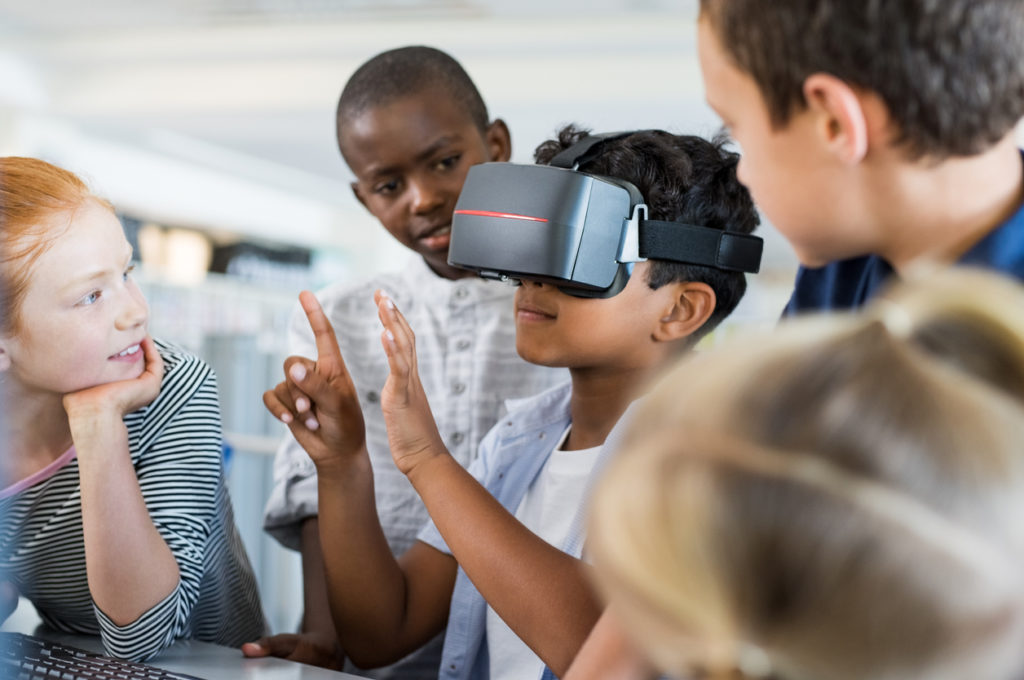
Augmented Reality (AR) is a rapidly growing technology that has the potential to revolutionize education and create new opportunities for learning. By superimposing digital information onto the real world through devices like smartphones, tablets, or AR glasses, AR enhances our perception of reality and provides immersive experiences that can engage students in ways previously unimaginable.
One of the key benefits of using AR in education is its ability to make learning more interactive and engaging. Instead of just reading about a concept in a textbook or listening to a lecture, students can experience it firsthand through AR simulations. For example, instead of simply learning about ancient civilizations in history class, students can use AR to explore virtual reconstructions of ancient cities, interact with historical figures, and witness important events as if they were actually there.
This hands-on approach not only makes learning more enjoyable but also helps students retain information better. Research has shown that incorporating AR into lessons can improve student motivation and engagement levels significantly. When students are actively involved in their learning process and have fun while doing so, they are more likely to remember what they have learned long after the lesson is over.
Furthermore, AR enables educators to cater to different learning styles and abilities by providing personalized experiences for each student. Teachers can create custom AR content tailored to individual needs, allowing students to learn at their own pace and focus on areas where they may need extra help. This level of customization ensures that every student has access to high-quality educational resources regardless of their unique strengths or challenges.
Another advantage of using AR in education is its ability to bridge the gap between abstract concepts and real-world applications. By visualizing complex ideas in a tangible way, AR helps students grasp difficult concepts more easily and understand how they relate to everyday life. For instance, instead of struggling with theoretical physics equations on paper, students can use AR models to see how these principles apply in practical scenarios such as engineering or architecture.
Moreover, AR fosters collaboration among students by enabling them to work together on projects in shared virtual spaces. Whether it’s solving puzzles as a team or conducting virtual experiments collaboratively, AR encourages communication and teamwork skills essential for success both inside and outside the classroom. Students can connect with peers from different locations seamlessly through AR platforms, promoting cultural exchange and global awareness among young learners.
In addition to enhancing traditional subjects like math or science, AR also opens up new possibilities for teaching emerging technologies such as coding or artificial intelligence. By immersing students in virtual coding environments where they can visualize algorithms at work or experiment with AI algorithms firsthand through simulation games powered by AR technology; educators can prepare them for future careers in tech-driven industries effectively.
Furthermore,
employers increasingly value candidates who possess strong technological skills; integrating
AR into school curricula equips students with practical experience using cutting-edge tools
and preparing them for jobs requiring proficiency
in augmented reality development;
design,
or utilization.
Lastly,
the potential applications
of
AR extend beyond academic settings;
it could be used
to provide vocational training
for specialized fields like healthcare,
engineering,
or aviation.
For example,
medical schools might use
AR simulations
to train surgeons on complex procedures without risking patient safety,
while engineering programs could offer hands-on experience designing structures within virtual environments.
In conclusion,
Augmented Reality holds immense promise
for transforming education
and creating dynamic
learning experiences
that inspire curiosity,
foster creativity,
and prepare students
for an ever-evolving workforce.
By harnessing the power
of this innovative technology,
educators
can unlock
new possibilities
for teaching
and shape
a brighter future
for generations
to come.
 Alternative Amie
Leave a comment