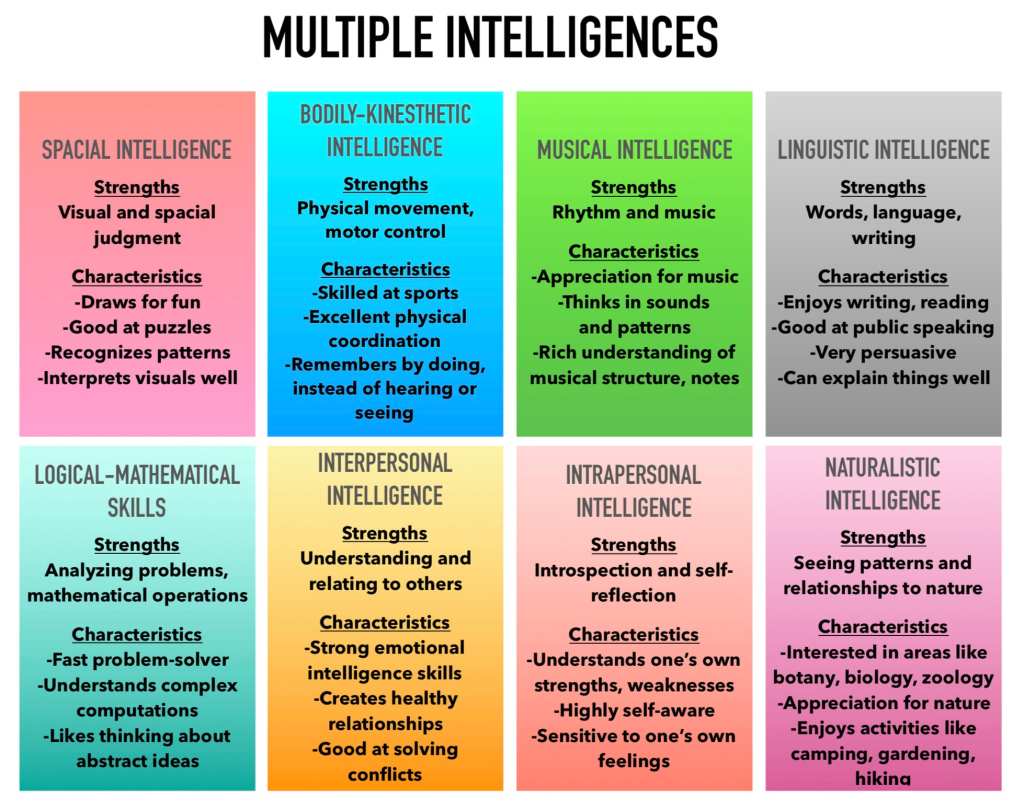
Multiple Intelligences Theory: An Overview of Alternative Approaches to Education
In traditional education systems, intelligence is often measured and defined solely by academic performance, primarily through standardized tests that focus on linguistic and logical-mathematical skills. However, this narrow view of intelligence fails to recognize the diverse ways in which individuals learn and excel. In response to this limitation, Howard Gardner introduced the theory of Multiple Intelligences (MI) in 1983 as an alternative framework for understanding human potential. This theory suggests that there are different types of intelligences, each representing a unique cognitive ability or talent. By embracing this concept, educators can tap into students’ strengths and provide a more inclusive and personalized approach to learning.
Gardner’s original model identified seven distinct intelligences: linguistic, logical-mathematical, spatial, bodily-kinesthetic, musical, interpersonal, and intrapersonal. Linguistic intelligence refers to proficiency in language usage such as reading comprehension or storytelling. Logical-mathematical intelligence involves strong analytical thinking and problem-solving skills. Spatial intelligence relates to visual perception and the ability to mentally manipulate objects in space.
Bodily-kinesthetic intelligence recognizes physical coordination and dexterity as valuable forms of intelligence seen in athletes or dancers who exhibit exceptional body control. Musical intelligence encompasses sensitivity towards rhythm, melody recognition or composition capabilities. Interpersonal intelligence focuses on social interaction skills like empathy or leadership qualities while intrapersonal intelligence emphasizes self-awareness and introspection.
Since Gardner’s initial formulation of MI theory, he has proposed additional intelligences such as naturalist (an affinity for nature) and existential (the capacity for exploring philosophical questions). These additions further broaden the scope of intelligences recognized within educational contexts.
One significant implication of Multiple Intelligences Theory is its potential impact on curriculum design. By acknowledging the diverse range of student abilities beyond academics alone – such as artistic talents or interpersonal skills – educators can create learning experiences that cater to different intelligences. This approach fosters a more inclusive educational environment where students of varying abilities can thrive.
For example, in a traditional classroom, the focus might be on textbook-based learning with an emphasis on reading and writing (linguistic intelligence). However, by integrating other intelligences into the curriculum, such as incorporating music or movement activities (musical and bodily-kinesthetic intelligence), educators can engage students who may struggle with conventional teaching methods. This not only enhances their learning experience but also boosts their confidence and overall academic performance.
It is worth noting that Multiple Intelligences Theory contributes to a shift from the one-size-fits-all model of education towards individualized instruction. Recognizing and nurturing each student’s unique strengths allows for personalized learning plans tailored to their specific needs. By doing so, educators empower students to develop their talents fully while improving areas they may find challenging.
Incorporating MI theory into classrooms requires teachers to adopt diverse instructional strategies that cater to various intelligences. For instance, visual aids like diagrams or videos support spatial learners while hands-on activities are suitable for those with strong bodily-kinesthetic intelligence. Collaborative projects facilitate interpersonal learners’ growth through group work and discussion while solitary reflection tasks suit individuals who possess intrapersonal intelligence.
Applying MI theory also encourages schools to expand beyond traditional assessments based solely on standardized tests. Instead, alternative assessment methods such as portfolios or project-based evaluations can better capture students’ progress across multiple intelligences. These assessments provide a comprehensive view of student capabilities by evaluating skills in different domains rather than focusing solely on academic achievement.
While Multiple Intelligences Theory has gained recognition within education circles worldwide, it does have its critics. Some argue that the concept lacks empirical evidence or claim it is too subjective compared to traditional approaches rooted in cognitive psychology theories like general intelligence (g-factor). Critics assert that defining “intelligence” broadly dilutes its meaning and may result in a less rigorous education system.
Despite these criticisms, the theory of Multiple Intelligences continues to shape educational practices and challenge traditional notions of intelligence. It emphasizes the importance of valuing and nurturing diverse talents, allowing students to excel in domains that align with their strengths. By embracing this holistic approach to education, educators empower students by recognizing their unique abilities and creating an inclusive learning environment that honors individual differences.
 Alternative Amie
Leave a comment