Montessori Education: A Method that Nurtures Independent, Lifelong Learners
In a traditional classroom setting, students often find themselves confined to desks and forced to adhere to rigid schedules. However, in Montessori education, an alternative approach is taken—one that emphasizes independence, hands-on learning experiences, and individualized instruction. Developed by Dr. Maria Montessori in the early 1900s, this educational method has gained popularity worldwide for its ability to foster independent thinking and lifelong love of learning.
At the core of Montessori education is the belief that children are naturally curious and have an innate desire to learn. The role of educators within this framework is not to fill empty vessels with knowledge but rather guide children on their own unique paths of discovery.
Classrooms in Montessori schools are carefully designed environments filled with age-appropriate materials that encourage exploration and independent learning. These materials are meticulously crafted to help children develop their cognitive, physical, social-emotional, and sensory skills.
One key aspect of Montessori education is the emphasis on mixed-age classrooms. Instead of grouping students solely based on their age or grade level, these classrooms typically include a three-year age span (e.g., 3-6 years old). This setup allows younger students to learn from older peers while providing older students with opportunities for leadership and mentorship.
The curriculum in a Montessori school covers various subjects such as language arts, mathematics, science, history/geography, practical life skills (e.g., cooking), arts/music appreciation—all integrated into real-life contexts. Rather than following a predetermined syllabus or set schedule dictated by the teacher or school administration alone; students are encouraged to follow their interests at their own pace within broad guidelines set by the curriculum.
In a typical day at a Montessori school, you might find children engaged in self-selected activities across different areas of the classroom—working independently or collaboratively. The teacher, known as a guide or facilitator, moves around the classroom providing individualized instruction and support when needed. This approach allows students to take ownership of their learning, develop problem-solving skills, and build self-confidence.
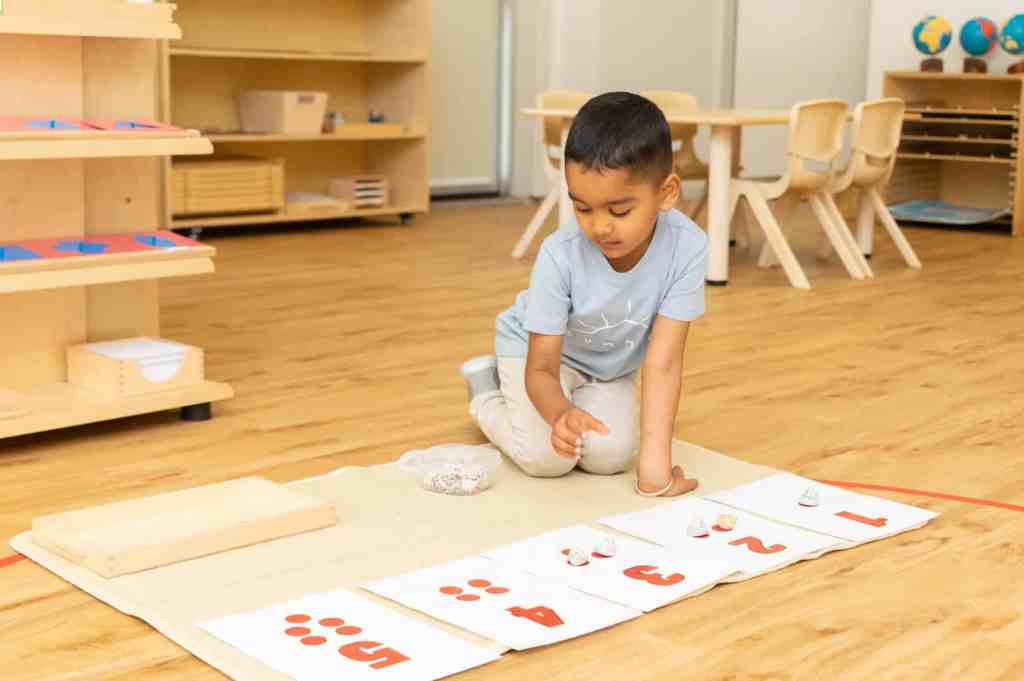
One key characteristic of Montessori education is the focus on hands-on learning experiences. Children are encouraged to use manipulative materials to explore concepts and develop concrete understandings before moving on to abstract ideas. For example, in mathematics, students might work with specially designed counting tools such as beads or cubes that help them grasp numerical concepts through tactile experiences.
Another important aspect of Montessori education is the emphasis placed on practical life skills. These skills include tasks like pouring liquids, tying shoelaces, buttoning shirts—all activities that promote independence and fine motor development. Practical life activities not only help children become more self-reliant but also foster a sense of responsibility and respect for themselves and their environment.
Montessori education also highlights the importance of fostering social-emotional development alongside academic growth. Through mixed-age classrooms, cooperative projects, and conflict resolution techniques taught by teachers; children learn how to communicate effectively, collaborate with others from diverse backgrounds, and navigate interpersonal relationships—skills crucial for success in today’s interconnected world.
Critics argue that Montessori education may lack structure or fail to prepare children for traditional educational settings later in life; however research has shown otherwise. Numerous studies have highlighted the positive outcomes associated with Montessori education—including increased academic achievement; improved social skills; enhanced creativity; greater love for learning; higher levels of motivation among students.
Montessori schools have gained popularity across different cultures worldwide due to their ability to nurture independent thinkers who are intrinsically motivated learners—a testament to Dr. Maria Montessori’s vision over a century ago.
In conclusion, Montessori education offers an alternative approach where children are given the freedom within limits—the freedom to explore their interests while guided by a carefully prepared environment and knowledgeable teachers. By emphasizing independence, hands-on learning experiences, and individualized instruction; Montessori education fosters lifelong learners who are well-equipped to navigate the complexities of our ever-evolving world.
 Alternative Amie
Leave a comment