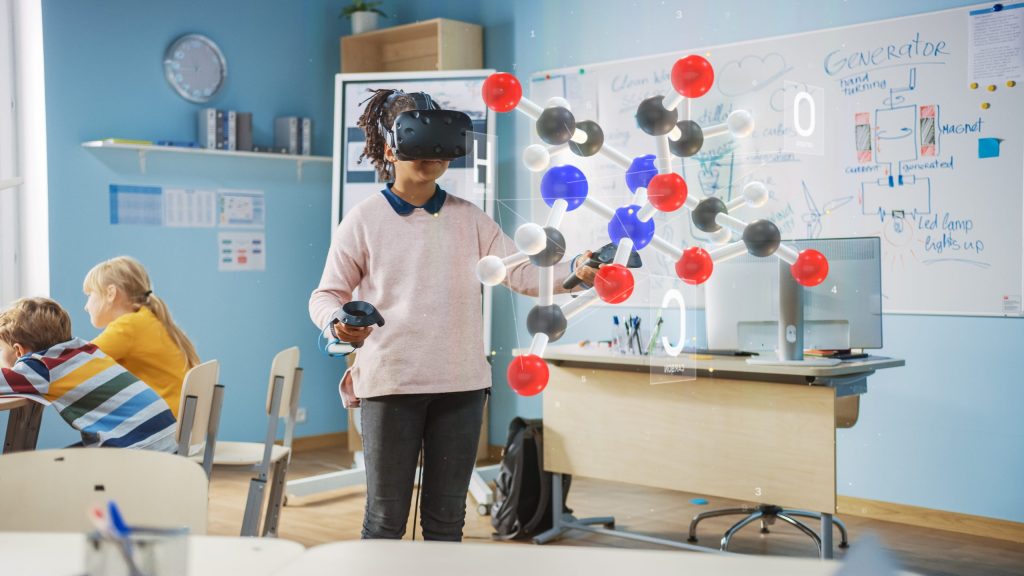
Augmented Reality: Revolutionizing Education
In recent years, technology has been rapidly transforming various industries, and education is no exception. One of the most promising advancements in this field is augmented reality (AR). Augmented reality is a technology that superimposes computer-generated content onto real-world environments, enhancing the user’s perception and interaction with their surroundings.
AR has immense potential to revolutionize education by making learning more engaging, interactive, and immersive. Unlike traditional teaching methods that rely heavily on textbooks and lectures, AR brings abstract concepts to life through visualizations and simulations. Students can see three-dimensional models of complex structures or historical landmarks right in front of them, allowing for a deeper understanding and retention of information.
One area where AR has shown considerable promise is in science education. With AR applications, students can explore virtual galaxies or dissect digital organisms without the need for expensive equipment or physical specimens. This not only saves costs but also enables students to undertake experiments that would otherwise be impossible due to safety concerns or limited resources.
Furthermore, foreign language instruction can greatly benefit from AR technology. Learners can practice conversational skills with virtual native speakers who respond intelligently based on speech recognition algorithms. This provides an authentic language-learning experience even outside the classroom.
Another significant advantage of AR lies in its ability to cater to different learning styles and abilities. By integrating text-to-speech functionalities into AR apps, visually impaired students can access educational content independently. Similarly, kinesthetic learners can interact physically with virtual objects within their environment rather than relying solely on visual or auditory cues.
Moreover, collaborative learning experiences are enhanced through shared AR environments where students can work together remotely on projects or problem-solving tasks using augmented objects and tools.
Although still relatively new in mainstream education systems, several pilot programs have already demonstrated the positive impact of incorporating AR into classrooms. For instance, studies have shown increased student engagement levels as well as improved knowledge retention compared to traditional teaching methods.
However, there are challenges to consider when implementing AR in education. One concern is the availability of devices and reliable internet access for all students. Additionally, ensuring that AR applications align with curriculum guidelines and learning objectives requires careful planning and development.
In conclusion, augmented reality has the potential to transform education by providing immersive and interactive learning experiences. From science experiments to foreign language practice, AR opens up new possibilities for engaging students across various subjects. As technology continues to advance, it is crucial for educators and policymakers to embrace this innovative tool and harness its full potential for alternative schooling and education.
 Alternative Amie
Leave a comment