Montessori Method for Children with Special Needs
The Montessori method is a unique educational approach that focuses on fostering independence, self-directed learning, and the development of practical life skills in children. While originally designed for typically developing children, the Montessori philosophy has also shown great potential in supporting children with special needs.
Maria Montessori believed that every child is capable of learning and growing to their fullest potential when provided with an appropriately prepared environment and individualized guidance. This belief forms the foundation of the Montessori approach to education for all children, including those with special needs.
One key aspect of the Montessori method that benefits children with special needs is its emphasis on hands-on learning materials. These materials are designed to be engaging, multisensory, and self-correcting, allowing children to explore concepts at their own pace and reinforce their understanding through active manipulation.
In a Montessori classroom for children with special needs, adaptations are made to accommodate different abilities and learning styles. For example, if a child has limited fine motor skills, larger or modified versions of materials may be used to enable them to participate fully in activities. Similarly, if a child has sensory sensitivities or challenges related to attention or focus, modifications can be made to create a more conducive learning environment.
Another important feature of the Montessori approach is its focus on promoting independence and self-care skills. This aspect is particularly valuable for children with special needs who may face additional challenges in these areas. Through practical life activities such as pouring water into cups or dressing themselves using specially designed dressing frames, children develop fine motor skills while gaining confidence in their ability to take care of themselves.
The role of the Montessori teacher in supporting children with special needs is crucial. Teachers undergo specialized training not only in implementing the Montessori curriculum but also in observing each child’s individual strengths and challenges. They provide personalized guidance and support tailored to each child’s unique needs, allowing them to progress at their own pace and reach their full potential.
Furthermore, the mixed-age classrooms typical of Montessori settings promote a sense of community and peer support. Older children naturally take on leadership roles and serve as mentors for younger ones. This dynamic creates an inclusive environment where children with special needs can feel accepted and supported by their peers.
Incorporating Technology in the Montessori Classroom
Technology is becoming increasingly prevalent in education, and the Montessori method is no exception. While Montessori education traditionally emphasizes hands-on materials over technology, there are ways to thoughtfully integrate technology into the classroom while still staying true to the core principles of the approach.
When incorporating technology into a Montessori classroom, it is important to consider its purpose and how it aligns with the goals of promoting independent learning and exploration. Instead of using technology for passive consumption or entertainment purposes, it should be used as a tool that enhances learning experiences and supports individualized instruction.
One way technology can be utilized in a Montessori classroom is through interactive educational apps or software that align with the curriculum. These digital resources can provide additional practice or extension activities for students who may benefit from extra reinforcement or challenge in certain areas.
For example, there are math apps that allow children to manipulate virtual manipulatives just like they would physical ones. This provides a multisensory experience while offering immediate feedback on their work. Similarly, language apps can offer interactive reading exercises or vocabulary-building games that cater to different reading levels.
Another way technology can enhance the Montessori classroom is through multimedia resources that bring real-world experiences into the learning environment. Virtual field trips, videos showcasing cultural celebrations from around the world, or live video conferences with experts in various fields can broaden children’s horizons beyond what may be available locally.
Additionally, technology can facilitate communication between teachers and parents/guardians. Online platforms or apps can be used to share updates, photos, and videos of children’s activities. This strengthens the home-school connection and allows parents/guardians to have a window into their child’s Montessori experience.
However, it is important to strike a balance between technology use and hands-on experiences in a Montessori classroom. The physical materials remain an essential component of the approach as they provide concrete, tangible learning opportunities that engage multiple senses. Technology should not replace these materials but rather complement them.
Therefore, when selecting technology tools for the Montessori classroom, it is important to choose those that align with the principles of active engagement and self-directed exploration. The focus should be on fostering independent thinking, problem-solving skills, and creativity rather than encouraging passive consumption or rote learning.
Montessori Approach to Teaching Mathematics
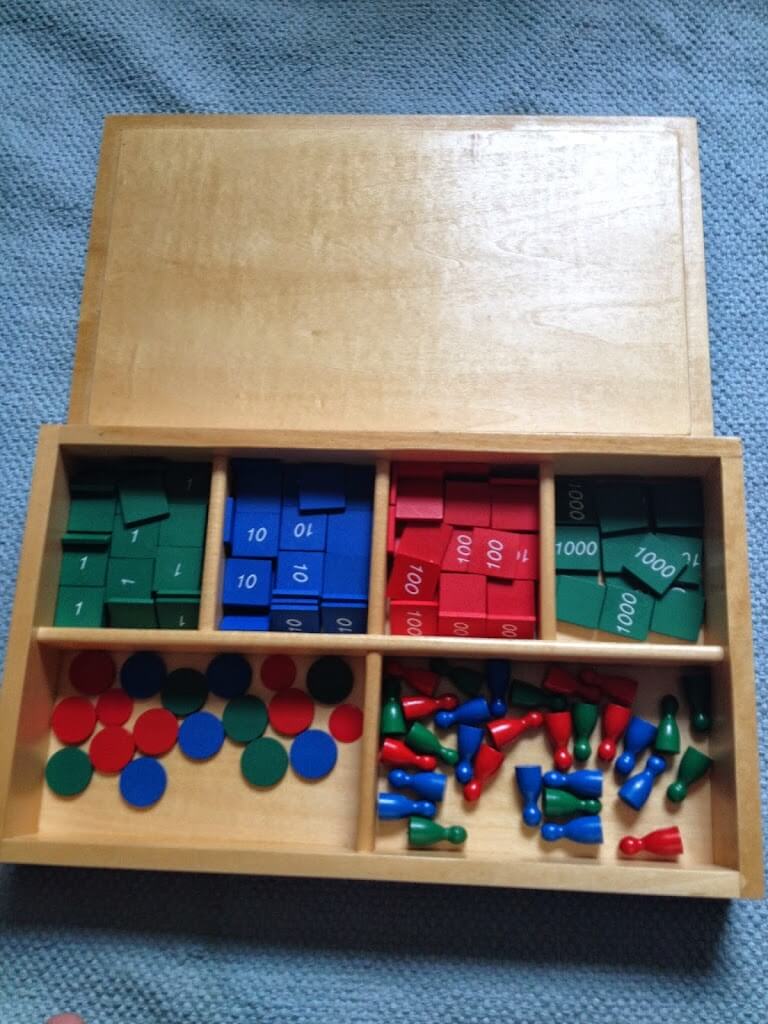
The Montessori approach to teaching mathematics is based on the belief that children are naturally inclined to explore mathematical concepts when provided with appropriate materials and guidance. Maria Montessori developed a comprehensive set of manipulative materials specifically designed to support children’s understanding of fundamental mathematical concepts from concrete to abstract.
In a Montessori classroom, mathematics instruction begins with hands-on materials that allow children to physically manipulate quantities and symbols. These materials include number rods, sandpaper numerals, spindle boxes, golden beads representing units and tens blocks (and later hundreds), among others.
Through repeated sensorial experiences with these materials over time, children develop a deep understanding of fundamental mathematical concepts such as place value, addition/subtraction operations,
multiplication/division operations,
fractions,
decimals,
square roots,
exponents etc.,
 Alternative Amie
Leave a comment