Cultural Awareness and Appreciation Through Bilingual Education
In today’s increasingly interconnected world, cultural awareness and appreciation have become essential skills for individuals to thrive in a global society. One effective way to foster these qualities in young learners is through bilingual education. By immersing students in two languages, this educational approach not only enhances their linguistic abilities but also deepens their understanding of different cultures.
Bilingual education encompasses various models, such as dual-language programs or immersion schools, where students receive instruction in two languages simultaneously. This method allows children to develop fluency in both languages while gaining valuable insights into the associated cultures. As they learn new vocabulary, grammar rules, and idiomatic expressions, students also acquire knowledge about the traditions, customs, art forms, and history tied to each language.
One significant advantage of bilingual education is that it encourages empathy and respect towards other cultures. By experiencing firsthand the richness of diverse perspectives embedded within different languages, students broaden their horizons beyond their own culture’s boundaries. They gain an appreciation for the unique contributions each culture brings to humanity as a whole.
Moreover, bilingual education fosters cross-cultural communication skills from an early age. When children are exposed to multiple languages during their formative years, they become more adept at navigating intercultural situations with ease and sensitivity. They develop a sense of adaptability that enables them to connect with people from different backgrounds effortlessly.
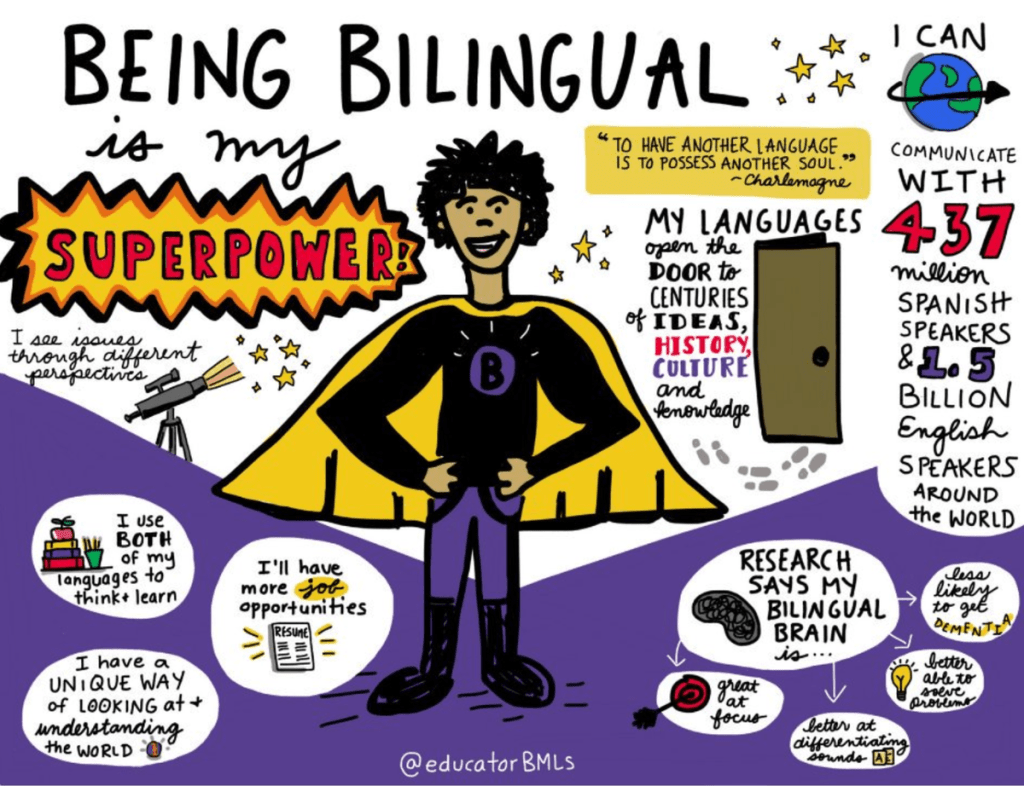
Studies have shown that bilingualism can also enhance cognitive abilities such as problem-solving skills and creativity. The constant mental exercise required when switching between two languages strengthens brain connections related to executive functions like attention control and task-switching capabilities. These neural adaptations provide invaluable advantages throughout life by promoting flexible thinking patterns.
Furthermore, bilingual education promotes inclusivity by valuing diversity within classrooms. Students who speak different native languages can share their linguistic expertise with peers while learning together collaboratively—a process known as peer-teaching—which further enriches the learning environment for all participants. This approach nurtures a sense of belonging and encourages students to embrace their cultural heritage while appreciating others’ backgrounds.
Bilingual education is not limited to language acquisition; it also serves as a bridge between cultures. By learning about another culture’s language, students gain insight into its values, traditions, and history. This knowledge forms the basis for intercultural understanding and respect in an increasingly interconnected world.
In conclusion, bilingual education offers an invaluable opportunity for young learners to develop cultural awareness and appreciation. It goes beyond simply acquiring language skills by immersing students in different cultures, fostering empathy, enhancing cognitive abilities, promoting inclusivity, and building bridges between diverse communities. By embracing bilingual education as part of alternative schooling approaches, we can empower future generations with the tools they need to navigate a globalized world with respect and understanding for all cultures.
 Alternative Amie
Leave a comment