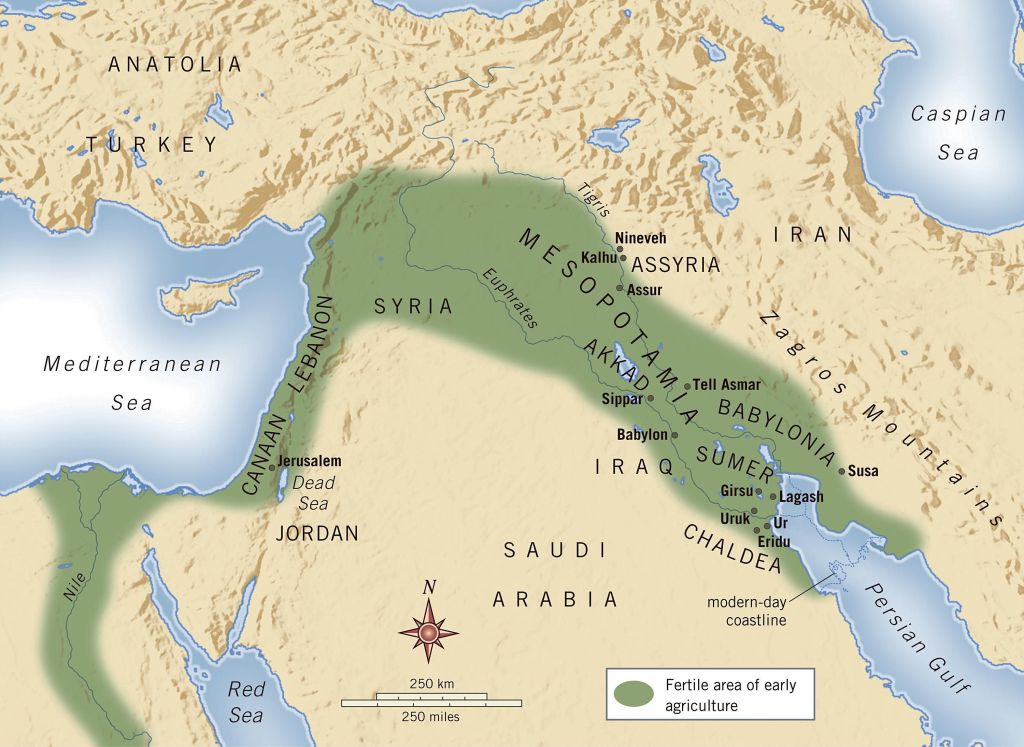
Mesopotamia, often referred to as the “cradle of civilization,” was an ancient region located in present-day Iraq and parts of Syria and Turkey. This area witnessed the birth of one of the earliest civilizations in human history, dating back to around 10,000 BCE. Mesopotamian civilization thrived for thousands of years and left behind a rich legacy that continues to captivate historians and archaeologists today.
Geographically, Mesopotamia was situated between two major rivers: the Tigris and Euphrates. These rivers provided fertile land for agriculture, which played a crucial role in the development of this civilization. The people living in this region learned how to harness the power of these rivers by constructing irrigation systems that allowed them to cultivate crops like wheat, barley, dates, and various vegetables.
One of the most remarkable aspects of Mesopotamian civilization was its advanced urban centers. Cities such as Uruk, Ur, Babylon, and Nineveh emerged as bustling hubs where commerce flourished. These cities were characterized by monumental architecture like ziggurats (stepped temples) that served both religious and administrative purposes. Additionally, they boasted intricate road networks connecting different regions within Mesopotamia.
The social structure of ancient Mesopotamia was hierarchical with kings at the top followed by priests/religious leaders, bureaucrats/administrators/military officials/scribes in middle positions; merchants/traders/artisans below them; finally ending with farmers/slaves at the bottom rung. Kings held immense power over their subjects but were also considered representatives or intermediaries between gods and humanity.
Religion played a significant role in daily life during this time period. The Mesopotamians believed in polytheism – worshiping multiple gods who controlled various aspects of nature and society. Temples were central institutions where priests conducted rituals on behalf of their communities seeking divine favor for protection against natural disasters or military threats. The Epic of Gilgamesh, an ancient Mesopotamian poem, recounts the adventures of a legendary king and highlights the importance of gods and goddesses in their lives.
Mesopotamia was also renowned for its advancements in intellectual pursuits. They developed one of the earliest systems of writing known as cuneiform, which involved making wedge-shaped marks on clay tablets using a stylus. These tablets served various purposes, from recording economic transactions to preserving literary works such as myths and epics.
Education played a vital role in Mesopotamian society, primarily for the elite class. Schools were established to teach reading, writing, mathematics, religion, law, and other subjects necessary for administrative positions. Scribes held esteemed positions within society due to their ability to read and write fluently.
Trade was another crucial aspect of this civilization’s success. Thanks to its strategic location between Asia Minor and the Arabian Peninsula, Mesopotamia became a hub for trade routes connecting different regions throughout the ancient world. Valuable resources like timber from Lebanon or precious stones from Afghanistan passed through these trade networks.
Despite all its achievements, however, Mesopotamian civilization faced numerous challenges throughout its existence. Frequent invasions by neighboring empires such as Assyria or Babylon led to periods of political instability and even outright conquests at times. The fall of Babylon to Persian forces in 539 BCE marked the end of independent Mesopotamian rule.
Nevertheless, the legacy left behind by this ancient civilization cannot be understated. Its contributions to architecture, literature (such as Enuma Elish – Babylonian creation myth), mathematics (including base-60 numeral system), astronomy (developing zodiac signs), medicine (codifying medical knowledge into texts called “diagnosis lists”), law codes (such as Hammurabi’s Code), and many more fields continue to influence human development today.
In conclusion, Mesopotamian civilization was a remarkable achievement of humanity. Its ability to create advanced urban centers, develop complex systems of writing, and make significant contributions to various fields sets it apart as one of the most influential civilizations in history. By studying this ancient society, we gain valuable insights into our own origins and how humans have shaped the world throughout millennia.

 Alternative Amie
Leave a comment