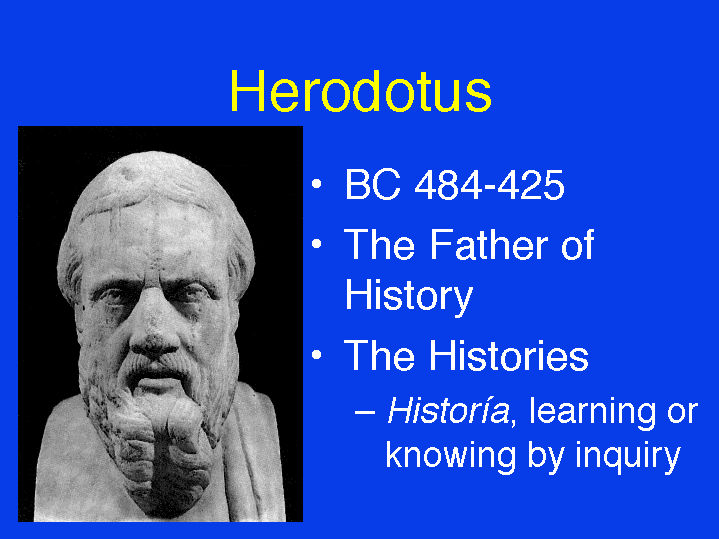
Herodotus, born in Halicarnassus, Asia Minor (modern-day Bodrum, Turkey) in 484 BCE, was an ancient Greek historian who is widely regarded as the father of history. He lived during a time when the Greeks were at their peak and Athens had become the center of intellectual and cultural life. Herodotus’ writing style was unique and different from other historians of his time because he wrote with great detail about people’s lives, customs, and traditions.
Herodotus traveled extensively throughout the Mediterranean world to gather information for his work. He interviewed eyewitnesses to events or their descendants who could recount stories passed down through generations. His works are not just dry descriptions of historical events but also contain anecdotes about people’s personalities and quirks that make them more relatable to readers.
One notable feature of Herodotus’ writing style is his use of digressions or tangents that interrupt the main narrative thread. These digressions often provide background information on topics such as geography, culture, religion or politics relevant to understanding the context of a particular event. They can be lengthy but serve to give readers a better understanding of how everything fits together.
Another hallmark feature of Herodotus’ writing style is his use of direct speech or dialogue between characters which makes his works more engaging than just description alone would be able to accomplish. Conversations between individuals provide insight into their thoughts and feelings on certain matters while also highlighting differences in viewpoints.
One example comes from Book VII where Herodotus recounts Xerxes’ march toward Greece in 480 BCE:
“As they [the Spartans] were preparing themselves for battle against Xerxes’ army at Thermopylae Pass, Leonidas (the Spartan king) received a message from Xerxes demanding that they lay down their weapons immediately.”
“Come now,” said Xerxes’s messenger Artabanos, “why do you [Spartans] persist in opposing us? You cannot hope to win this battle. Why not surrender and join our side? If you do so, I shall see that you are well rewarded.”
Leonidas replied: “If we surrendered to Xerxes, then Sparta would no longer be free. We value freedom more than life itself.”
This dialogue between Leonidas and Artabanos illustrates the values of the Spartans who were known for their bravery and willingness to fight till death. It also shows how Herodotus used direct speech as a way of bringing his characters to life.
Herodotus was not simply interested in recounting historical events but also sought to explain why they happened. He believed that human actions were motivated by certain factors such as culture, geography or religion, which is evident throughout his works.
For example, Herodotus explains the reason behind Persia’s invasion of Greece in Book I:
“This is how it came about that all Asia was enslaved by one man [Cyrus], who became king over them: he had defeated Croesus… Later on Cyrus attacked those Massagetae whom I have already mentioned; they dwelt eastward beyond the Araxes river… After this he planned an expedition against the Assyrians… conquered them…and after Assyria he marched against Libya.”
In this passage from Book I, Herodotus describes how Cyrus’ conquests led him eventually into contact with Greeks and therefore set up a chain reaction of events that culminated in Persia’s invasion of Greece under Xerxes decades later.
Finally, Herodotus’ writing style often includes moral lessons or reflections on human behavior which make his works relevant even today. For instance, at the end of Book III where Herodotus recounts the Persian Wars including Marathon (490 BCE) and Thermopylae (480 BCE), he writes:
“So ended the Persian War. From it we can learn that no human being is free from trials and misfortunes, and that in every victory there are both good and bad consequences.”
This reflection on the nature of warfare teaches readers about the unpredictability of life and how even in our successes there will always be costs.
In conclusion, Herodotus’ writing style was unique because he used digressions, direct speech between characters, explanations for historical events as well as moral reflections to bring his works to life. Through his works, modern readers gain a better understanding of ancient Greece and their own world today thanks to the lessons that he shared so long ago.
 Alternative Amie
Leave a comment