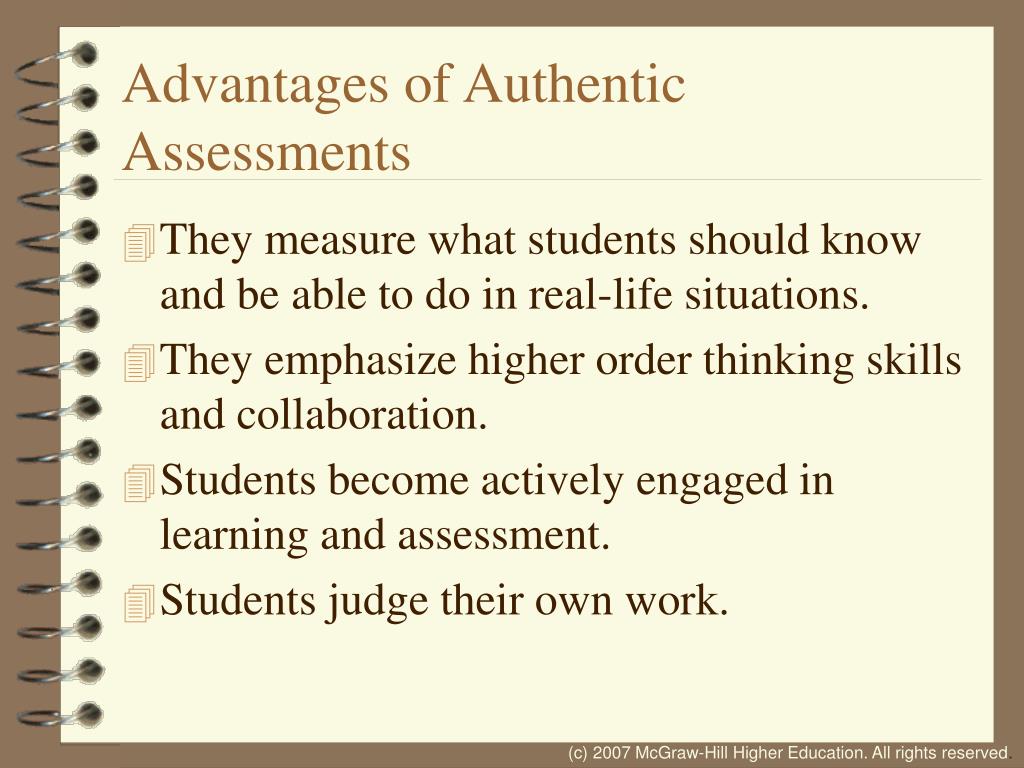
Authentic assessment is a form of evaluation that measures student learning through real-world tasks and activities. Unlike traditional assessments, which typically involve multiple-choice questions or standardized tests, authentic assessment puts students in situations that reflect real-life contexts and challenges.
Here are the top 15 benefits of using authentic assessment in education:
1. It promotes critical thinking
Authentic assessment requires students to analyze information, make decisions, and solve problems – all important skills for success in the real world. By engaging with complex tasks and scenarios, students develop their critical thinking abilities.
2. It encourages creativity
Authentic assessments often require students to think creatively and come up with innovative solutions to problems. This can help foster a love of learning by challenging students to think outside the box.
3. It helps build self-confidence
Because authentic assessments are tailored to each student’s strengths and interests, they allow for more personalized feedback than traditional tests. As a result, students feel more confident about their abilities when they see how they excel in certain areas.
4. It provides opportunities for collaboration
Many authentic assessments involve group work or collaboration with peers or experts in the field being studied. This allows for diverse perspectives on problem-solving approaches.
5. It prepares students for future careers
By exposing them to real-life situations, authentic assessment helps prepare students for future career challenges where they will be required to apply knowledge rather than simply regurgitate it from memory.
6. It supports mastery-based learning
Authentic assessment focuses on measuring mastery of particular skills rather than just memorization of information; this approach aligns well with competency-based education models that prioritize skill development over content coverage.
7. It fosters curiosity-driven learning
When given open-ended topics or projects related to their interests via an Authentic Assessment framework -students become curious learners who seek out answers themselves instead of waiting for someone else’s instruction-are encouraged towards creative exploration without fear-of-being-wrong attitude!
8. It provides instant feedback
Authentic assessments are often more immediate and hands-on than traditional tests, which can provide students with immediate feedback that helps them understand their progress.
9. It supports diverse learning styles
Authentic assessments can be tailored to the specific needs of each student, allowing for a wide range of learning styles to be accommodated.
10. It enhances motivation
Authentic assessment is more engaging than traditional testing methods because it allows students to connect what they learn in class with real-world experiences and challenges. This makes learning more meaningful and motivating.
11. It emphasizes communication skills
Many authentic assessments require students to communicate ideas or findings effectively in various formats like written reports, presentations, videos or animations etc- this helps enhance their communication skills for future professional scenarios as well.
12. It promotes lifelong learning
By focusing on mastery-based rather than coverage-based assessment, authentic assessment encourages students to continue learning throughout their lives; this approach also aligns well with the idea of continuous improvement through self-reflection and self-evaluation.
13. It fosters cultural competency
Authentic assessment often focuses on issues that are relevant to diverse communities; by engaging with these topics, students develop an understanding of different cultures and perspectives that will serve them well in all aspects of life.
14. It allows for differentiation
Teachers using Authentic Assessment can easily differentiate instruction based on each student’s unique needs- as it offers a variety of ways to assess student performance other than just one-size-fits-all standardized exams!
15. It measures what matters most
Lastly – Authentic Assessment measures what really matters: critical thinking skills, problem-solving abilities & creativity- things that cannot be measured by conventional testing methods alone but play a vital role in preparing students for success beyond school walls.
In conclusion, incorporating authentic assessment into education has numerous benefits that promote deeper understanding among learners while encouraging innovative thinking processes along with enhancing engagement levels towards academic content areas via practical approaches. By implementing this approach in classrooms, teachers can help students develop the skills and confidence they need to succeed in whatever path they choose.
 Alternative Amie
Leave a comment