Latin Language Studies: A Journey into the Ancient World
Learning Latin can be an exciting and rewarding journey for anyone interested in ancient history, literature, or language. Although Latin is considered a dead language since it’s not spoken as a mother tongue by any community today, its influence is still evident in modern languages like English, French, Spanish, and Italian.
In recent years, there has been a growing interest in Latin studies among students of all ages and backgrounds. From homeschoolers to college students and lifelong learners alike, people are discovering the value of studying this classical language that transcends time and place.
So why study Latin? Here are some compelling reasons:
1. Understanding the Roots of Western Civilization
The Roman Empire was one of the most influential civilizations in human history. Its legacy can still be seen today in fields such as law, engineering, architecture, art, philosophy, religion and politics. By learning Latin you will have access to primary sources from that time period such as Cicero’s speeches or Virgil’s epic poem “The Aeneid.” You will also gain insight into how Rome shaped modern Western culture.
2. Building Vocabulary
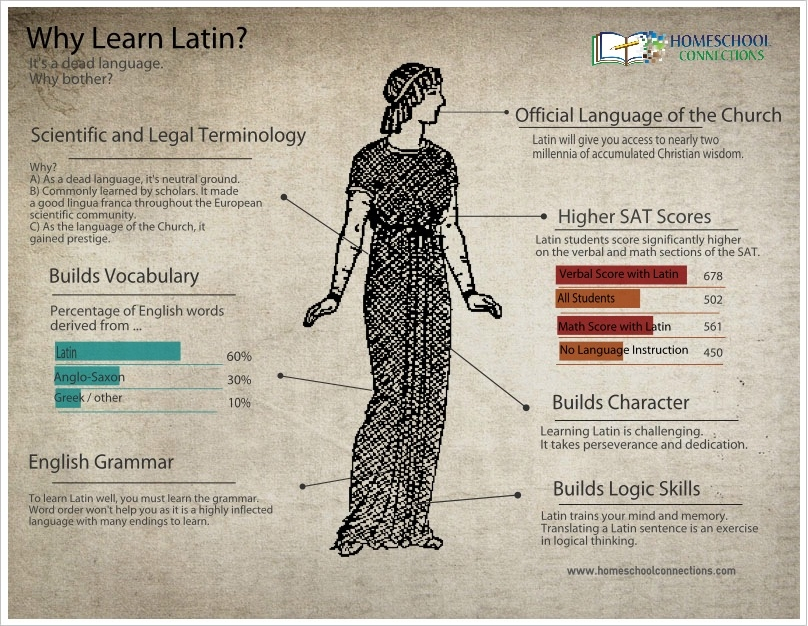
English vocabulary comes from many different sources including Germanic languages like Old Norse and Anglo-Saxon but also heavily from Romance languages like French or Spanish which themselves have roots in Latin. In fact up to 60% percent of all English words come from either Greek or Latin! Learning basic word roots helps make sense of scientific terms (such as biology), legal jargon (like habeas corpus) and medical terminology (such as cardiac arrest).
3. Enhancing Critical Thinking Skills
Studying grammar rules requires understanding complex grammatical structures that aren’t always intuitive at first glance – this demands both discipline & patience while improving logical thinking skills over time.
4. Boosting Job Prospects
Having knowledge of another language – especially one with significant historical importance – shows potential employers that you are a curious and engaged learner. It demonstrates that you have the ability to think critically, work hard, and build your skillset in an interdisciplinary way.
So what exactly does studying Latin entail?
Firstly, it’s important to note that there are different approaches depending on one’s goals. Some students may want to focus on reading classical texts like Caesar’s “Gallic Wars” or Ovid’s “Metamorphoses.” Others might prefer a more conversational approach with an emphasis on spoken language practice.
Regardless of your preferred method, here are some key concepts you’ll encounter during your studies:
1. Grammar
Latin grammar is complex but once you master its rules they become increasingly intuitive over time. Important grammatical structures include declension (the way nouns change form based on their case), conjugation (how verbs change according to tense), syntax (the order of words in a sentence) and agreement (ensuring subject-verb agreement).
2. Vocabulary
Learning vocabulary is essential for understanding any language – particularly one as nuanced as Latin! Many textbooks will introduce new vocabularies chapter by chapter so students can slowly build up their knowledge base over time.
3. Reading Comprehension
Reading comprehension is the ability to understand written text – which means reading Latin texts aloud won’t necessarily be enough if you don’t comprehend what they mean! This requires not just memorizing vocabulary but also understanding context & meaning through analysis of sentence structure or literary devices such as metaphor or alliteration.
4. Translation
Translation is the process of converting written text from one language into another – typically English in this case since most learners use translation as a tool for learning Latin rather than becoming proficient speakers themselves (although speaking proficiency can still be achieved with dedicated study). The aim of translation is not simply rendering words from one language into another – it involves crafting sentences that convey both literal meaning and implied nuance while staying true to the original author’s intent.
There are many resources available for those interested in studying Latin, including textbooks, online courses, and tutors. Some popular textbooks include Wheelock’s Latin and Lingua Latina Per Se Illustrata (LLPSI) which take different approaches but both offer a comprehensive overview of the language.
Online courses like Duolingo or Rosetta Stone can also be useful for beginners who want to get started with basic vocabulary and grammar before moving on to more advanced concepts. For those looking for a more personalized approach, individual tutors can provide tailored guidance based on specific interests or learning goals.
In addition to formal coursework, there are also opportunities to engage with Latin outside of traditional academic settings. Many museums offer exhibits showcasing ancient Roman art & artifacts while local Classics clubs may host events such as lectures or film screenings that explore various aspects of the ancient world.
Learning Latin not only provides access to an incredibly rich cultural legacy but it also sharpens critical thinking skills, builds vocabulary and enhances one’s job prospects – all valuable advantages regardless of one’s career path. Whether you’re interested in pursuing classical studies as a profession or simply curious about the history behind everyday words we use today (such as “et cetera” – meaning “and so forth”) – studying Latin is an enriching journey into the past that has relevance well into our future.
 Alternative Amie
Leave a comment