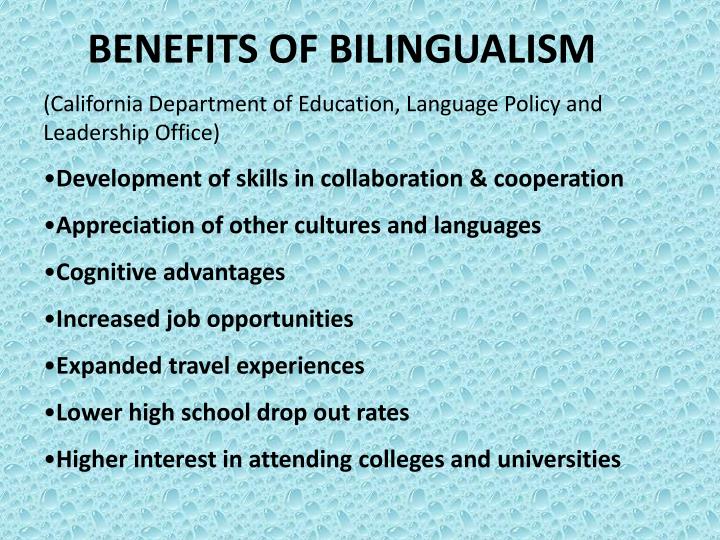
Bilingual education is a method of teaching that involves instruction in two languages, typically the student’s native language and the language of their country. Bilingual education offers many benefits to children, including increased cognitive development, better academic performance, improved cultural understanding and communication skills.
One of the primary advantages of bilingual education is that it helps students develop strong cognitive abilities. Studies have shown that individuals who are bilingual exhibit greater mental flexibility and problem-solving skills than monolinguals. This may be due to the way that learning multiple languages can help to rewire neural networks in the brain.
Another benefit of bilingual education is that it has been linked with better academic outcomes for students. Research has found that students who receive instruction in both their native language and a second language tend to perform better on standardized tests than those who do not.
Furthermore, bilingual education promotes cultural awareness and empathy by giving students exposure to different cultures through language study. Students gain insight into other ways of life through stories, songs, games and literature from another culture which fosters an appreciation for diversity.
In addition to these benefits for individual learners, bilingual education also plays an important role in promoting social cohesion within communities. By providing educational opportunities for immigrant families and minority groups while respecting their linguistic backgrounds this approach supports inclusion rather than assimilation or marginalization based solely on differences in speech or dialects spoken at home.
There are various types of bilingual educational programs available depending on the context: Immersion programs place non-native speakers into classrooms where only English -or any target language- is spoken all-day long; Dual-language programs provide instruction equally between two languages throughout each day; Heritage Language Programs focus exclusively on supporting speakers’ heritage or mother tongue while still integrating them into mainstream society.
However, despite its many benefits there remains some controversy around bilingual education as some believe it could hinder English proficiency acquisition if not properly implemented with evidence-based practices such as high quality teacher training, sufficient resources and materials, and appropriate support for students to master both languages.
In conclusion, bilingual education is a valuable asset for any student who seeks to become proficient in more than one language. It provides cognitive benefits as well as cultural understanding and empathy that can be useful across all aspects of life. Nevertheless, it is important to note that there are different methods of implementing bilingual education programs that should be considered carefully based on local context and needs of diverse learners.
 Alternative Amie
Leave a comment