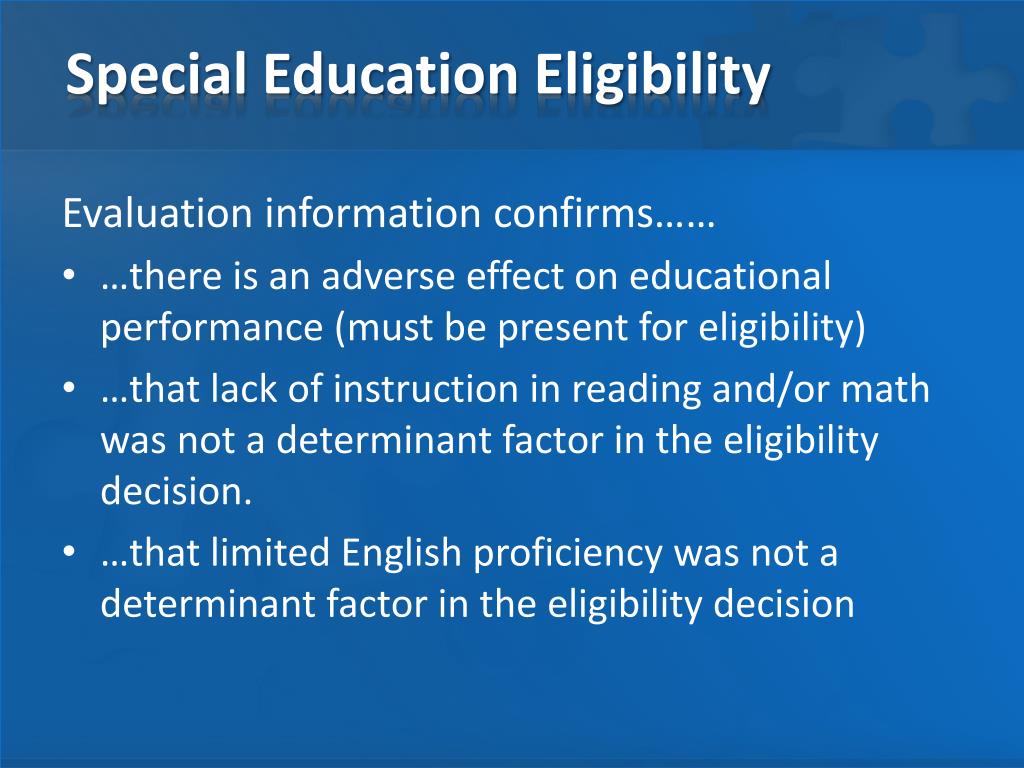
Special education services are crucial to ensuring that students with disabilities receive the necessary support and resources to succeed academically. However, not all students with disabilities are eligible for special education services. Eligibility criteria vary depending on the state or school district in which a student resides, but there are some general guidelines that most schools follow.
The Individuals with Disabilities Education Act (IDEA) is a federal law that outlines the rights of students with disabilities and their families. IDEA requires public schools to provide free and appropriate public education (FAPE) to all children with disabilities. To be eligible for special education services under IDEA, a student must meet two requirements:
1. The student must have a disability as defined by IDEA
2. The disability must adversely affect the student’s educational performance
IDEA identifies 13 categories of disabilities that qualify for special education services: autism, deaf-blindness, deafness, emotional disturbance, hearing impairment, intellectual disability, multiple disabilities, orthopedic impairment, other health impairment (such as ADHD), specific learning disability (such as dyslexia), speech or language impairment, traumatic brain injury and visual impairment.
If a student has one of these qualifying disabilities but does not need special education services because it does not adversely affect their educational performance or if they can make progress in general educational settings without such assistance then they may still be classified by schools under section 504 of the Rehabilitation Act which ensures them access to accommodations like preferential seating in classrooms etc.
Once a child has been identified as having a qualifying disability under IDEA or Section 504 they will undergo an assessment called an Individualized Education Plan meeting where teachers and parents meet up to come up with goals for academic achievement over time based on areas requiring improvement noted during evaluations.
It is important to note that eligibility alone does not guarantee access to special education services; each student’s needs are unique therefore individualized plans are needed for every case . Once eligibility is confirmed, the school will work with the student and their family to create an individualized education plan (IEP) which should be regularly reviewed and updated to reflect progress made.
In conclusion, eligibility criteria for special education services may vary depending on the state or district but IDEA’s requirements remain largely consistent across all states. Students must have a qualifying disability that adversely affects their educational performance to receive Special Education Services under IDEA or accommodation under Section 504 of the Rehabilitation Act. Determining eligibility is just one step in providing appropriate support for students with disabilities; once eligibility has been established it is important to work closely with families and educators to create an IEP tailored specifically for each child’s needs as determined by assessments conducted over time.
 Alternative Amie
Leave a comment