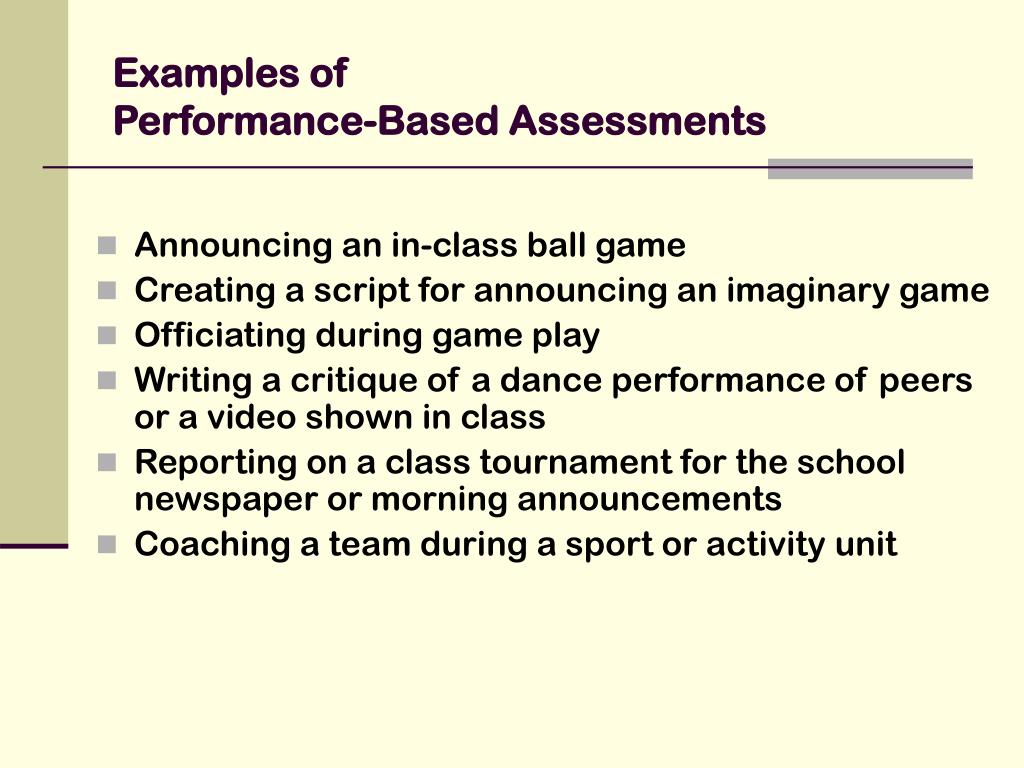
Performance-based assessments, also known as authentic assessments, are a form of evaluation that measures students’ abilities to apply their skills and knowledge in real-life situations. Instead of traditional tests that rely on recall and memorization, performance-based assessments provide opportunities for students to demonstrate their understanding through tasks or projects that mimic the challenges they may face outside of the classroom.
One significant advantage of performance-based assessments is that they provide a more accurate reflection of students’ capabilities than traditional testing methods. Rather than assessing just one aspect, such as content knowledge, performance-based assessments evaluate multiple dimensions such as critical thinking and problem-solving skills. Additionally, it allows teachers to assess each student’s progress individually instead of comparing them with their peers.
Another benefit is that these types of evaluations can be customized according to the needs and interests of each student. For instance, if a student enjoys art or music but struggles with math concepts, an assessment could be created where he or she applies math concepts in an artistic project they enjoy doing – this would help the teacher identify areas where comprehension is needed while still allowing for creativity expression.
Performance-based assessments are also highly engaging for most students because they give them ownership over their learning experience; this sense of ownership increases motivation levels considerably. When learners feel invested in what they’re doing – when they see its relevance and value – then independent work becomes much less daunting since it feels like something meaningful rather than arbitrary busywork assigned by someone else without context.
This mode of assessment can also help overcome some limitations presented by standardized testing since it provides invaluable insight into how individual learners approach problems or assignments. It helps educators understand what works best for each child so that adjustments can be made accordingly.
Performance-based evaluation comes in many forms: oral presentations, portfolios containing written work along with visual aids like pictures & videos; group projects where teams must collaborate effectively towards common goals; simulations – These may involve role-playing scenarios designed around specific topics (such as business or politics) or other interactive exercises that require students to apply critical thinking skills and knowledge.
Performance-based assessments are also effective in the sense that they encourage students to take responsibility for their learning. With traditional testing, it’s easy for students to feel like they’re being graded on things outside of their control, such as the difficulty of the questions asked. However, with performance-based assessment methods, learners know what is expected from them and can plan accordingly. This sense of ownership promotes greater engagement since each student knows that they have a personal stake in their academic success.
Furthermore, performance-based assessments can be useful tools for educators who want to differentiate instruction based on individual student needs. Teachers can use these evaluations to identify areas where specific learners need additional support while providing challenging tasks for others who excel in particular subject areas.
Because performance-based assessments focus more on real-world applications of knowledge and skills rather than rote memorization and recall, it is easier for teachers to incorporate creativity into lesson plans & assignments without sacrificing rigor or substance. When students are given opportunities to explore topics through hands-on projects or activities that tap into different intelligences (such as music or art), they are more likely to retain information over time since it becomes relevant within their context.
Finally, performance-based assessments help prepare students for life beyond school by exposing them early on to various problem-solving scenarios similar to those encountered later when working towards a career path. In this way, teaching strategies that emphasize authentic evaluation provide an excellent foundation upon which young people can build lasting skill sets while fostering independence along with self-efficacy – both crucial traits necessary for success in any field.
In conclusion, Performance-Based Assessments offer numerous benefits over traditional testing methods; not only do they evaluate multiple dimensions of learning but also provide invaluable insight into how children approach problems & assignments individually – promoting personalized instruction tailored towards individual needs/interests hence improving overall comprehension levels plus motivation & engagement levels too.
 Alternative Amie
Leave a comment